Nationwide Sales & Service - 01536 802333

Air bikes have a reputation: simple, brutally effective, and brilliant for full-body conditioning. The REP Strive™ Air Bike keeps everything people love about fan bikes and adds something genuinely new – Variable Pitch Resistance (VPR™), a mechanical system that lets you control resistance by changing the angle of the fan blades.
For anyone designing or upgrading a luxury home gym or garden room, that shift matters. Instead of resistance being tied only to how hard you pedal, the Strive Air Bike gives you eight distinct levels that you can dial in, independent of cadence.
At its core, the Strive is still very much an air bike: you get dual-action handles, fan-based resistance, and that familiar “the harder you go, the harder it hits back” feeling. The key difference is that you’re no longer locked into a single power curve dictated only by speed.
Traditional air bikes:
The Strive Air Bike rewrites that formula by mechanically adjusting fan blade pitch, giving you eight resistance levels from genuine low-intensity to strength-focused efforts.
VPR stands for Variable Pitch Resistance. Instead of adding magnets or electronics, REP uses a purely mechanical system: you move a lever to change the angle of the fan blades, and the airflow – and therefore resistance – changes.
In practice, that means:
Because the resistance is cadence-independent, you can sit at a given level and focus on output, technique, and breathing rather than chasing or fighting the fan curve.
For our luxury home gym client, every piece of kit has to earn its space. The REP Strive Air Bike does this by behaving like several different cardio tools in one footprint: low-intensity erg, classic air bike, and strength-focused conditioner.
Key benefits in a residential setting include:
In a garden room or studio-style gym, it becomes a conditioning anchor that still looks and feels premium enough to match the rest of the space.
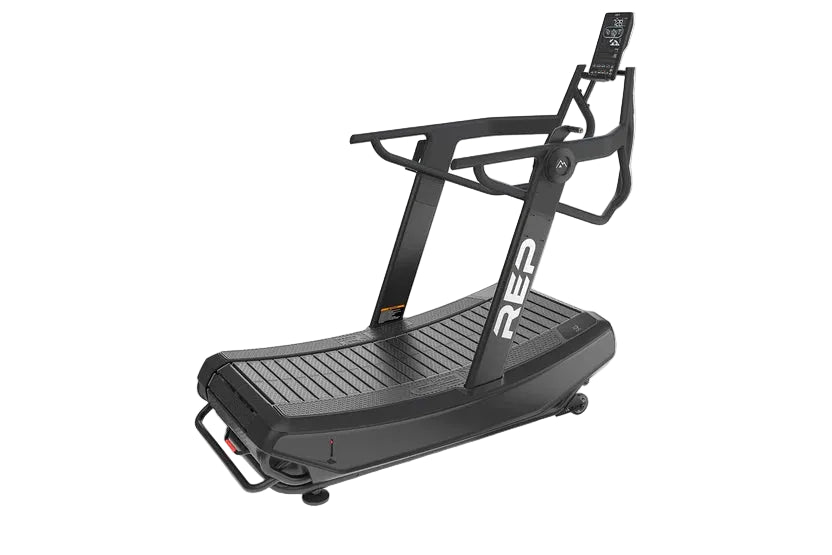
REP builds the Strive on a heavy-duty steel frame with a dual-stage belt drive, designed to feel solid under all-out efforts and repeat sprints. The console tracks key metrics such as time, distance, calories, RPM, speed, watts, and heart rate, with Bluetooth FTMS compatibility for app pairing.
In use, the main difference you feel compared with a standard air bike is how controlled the ride is: less “spiky” resistance, smoother cadence at moderate efforts, and a clearer distinction between light, medium, and heavy sessions via the VPR levels.
Because resistance is no longer fixed to one fan curve, the Strive can sit at the centre of several training styles.
In a well-planned home gym, that means you can rely on one air bike to cover warm-up, main conditioning work, and finisher, without needing multiple cardio pieces.
What is the REP Strive Air Bike?
It’s a premium air bike that uses fan-based resistance combined with Variable Pitch Resistance (VPR), giving you eight mechanical resistance levels independent of how fast you pedal.
Does it still use air resistance?
Yes. The REP Strive is fundamentally a fan bike; VPR simply adjusts the fan blade angle to change how much resistance the air provides at each level.
What exactly is VPR?
VPR (Variable Pitch Resistance) is a mechanical system that lets you change the pitch of the fan blades via a lever, creating low-, medium-, and high-intensity resistance levels without relying on electronics or magnets.
How many resistance levels does it have?
There are eight levels. Levels 1–3 are geared toward low-intensity and recovery work, 4–6 toward VO₂ max training, and 7–8 toward strength-oriented and all-out intervals.
Is the Strive Air Bike suitable for beginners?
Yes. The lower VPR levels make it much more accessible than a traditional “always-on” air bike, allowing new or deconditioned users to ride at manageable intensities while still having room to progress.
Can I use it for HIIT and sprints?
Absolutely. At higher levels and higher cadence, the Strive functions like a very demanding air bike, giving you the intensity needed for HIIT while still letting you control the resistance profile.
Is it good for longer steady-state sessions?
Levels 1–3 are specifically designed to make recovery and steady-state riding viable on an air bike, something fixed-fan designs often struggle with.
Does it train upper and lower body?
Yes. Like other air bikes, it uses dual-action handlebars paired with pedals, delivering full-body conditioning in a single movement pattern.
How noisy is the Strive Air Bike?
As a fan-based machine, it produces airflow noise, but the belt drive and overall build quality help keep the feel controlled and refined for home use.
What footprint and capacity should I plan for?
The Strive Air Bike has a stable footprint of approximately 57 × 27 × 53 inches (L × W × H) and is engineered to support users up to around 160 kg, making it suitable for most home and garden room gyms.
Does it need mains power?
No. Resistance is entirely mechanical, and the console is battery powered, with the option of an adapter if preferred.
Who is this bike best suited for?
It’s ideal for users who want the intensity and simplicity of an air bike but with a wider range of training options – from gentle recovery rides to high-output strength-endurance work – in a single, well-built machine.