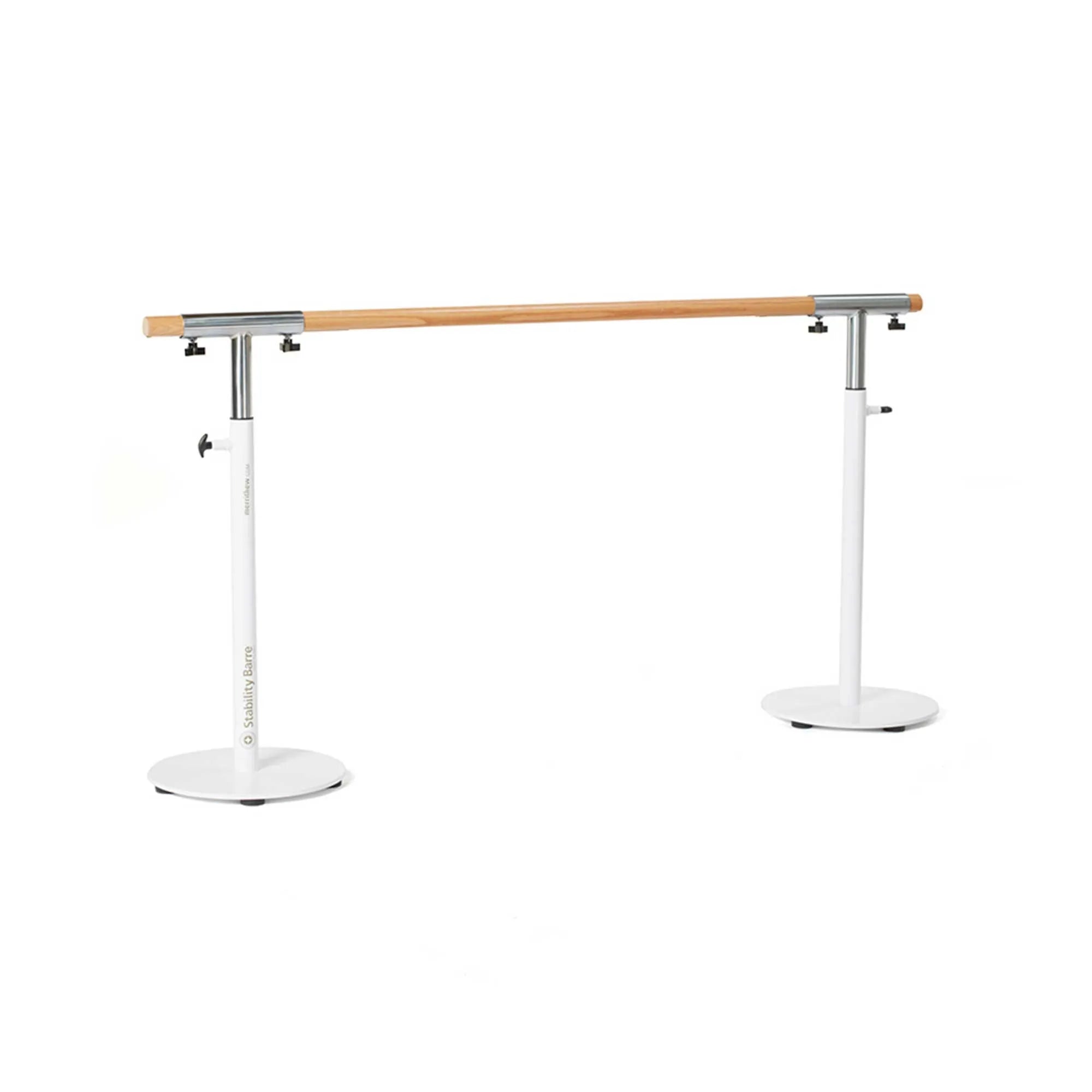
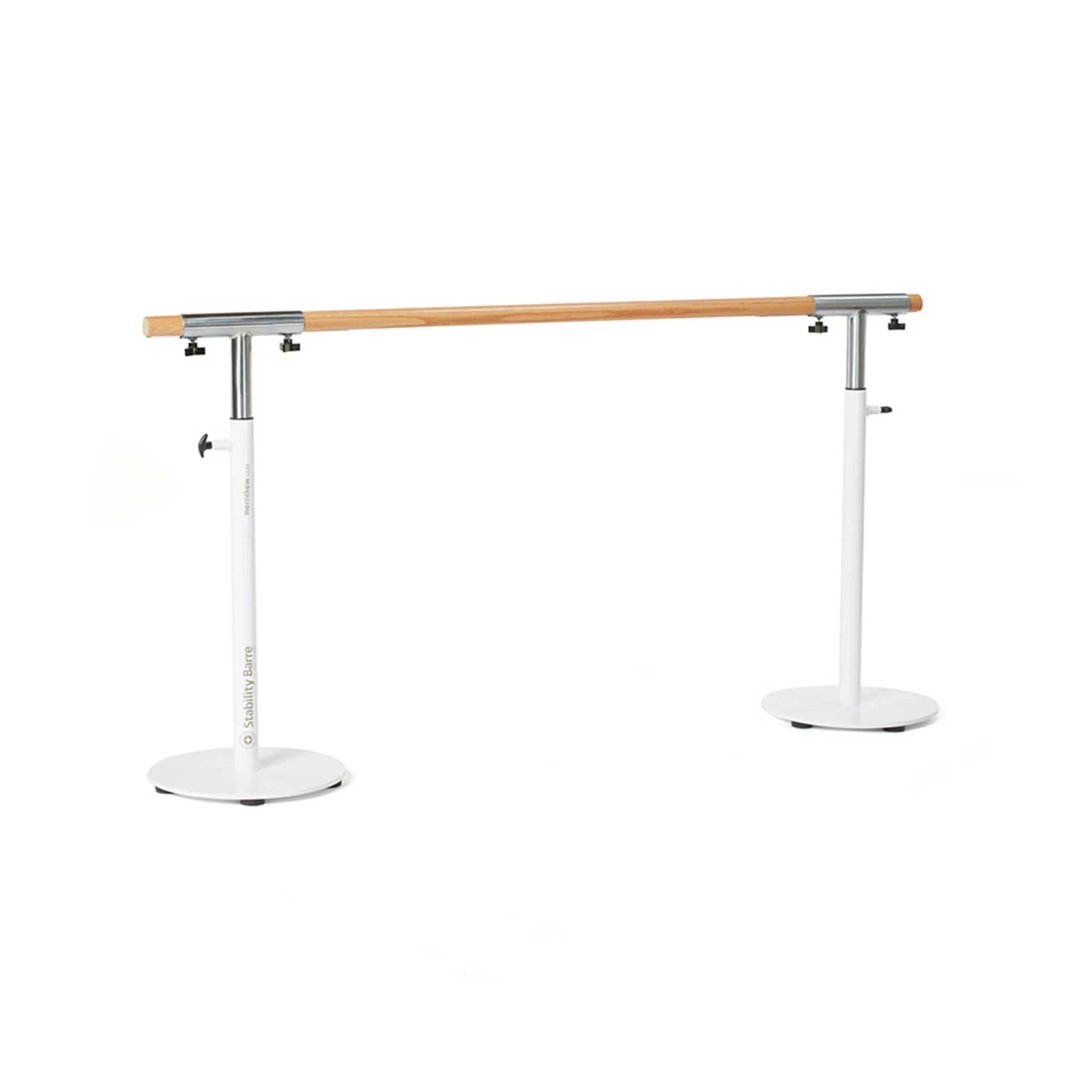
Stability Barres Key Features
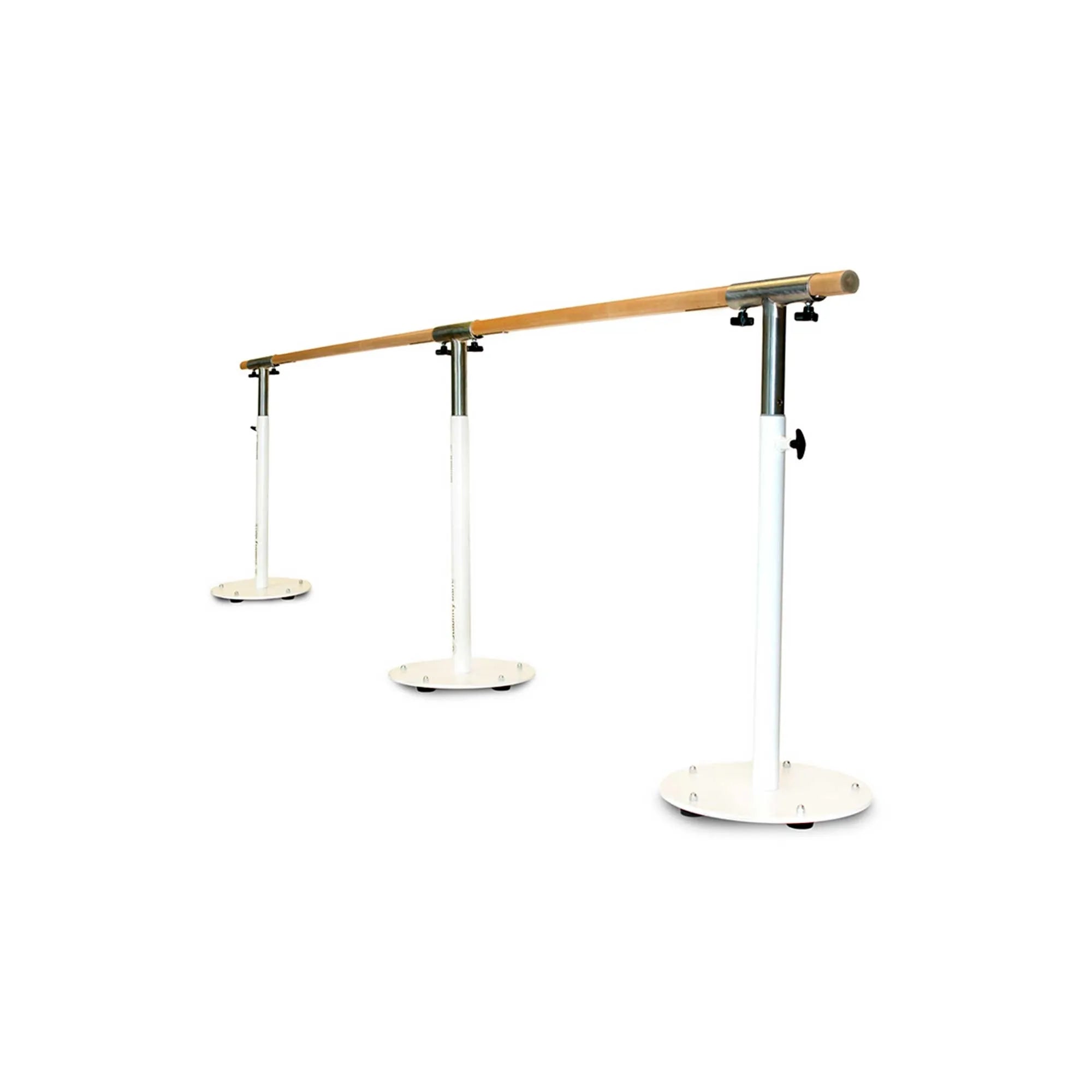
- Freestanding Stability Barres
Professional-grade solid steel construction with adjustable height (93-112cm / 36.5-44 inches). Weighted circular bases provide rock-solid stability with non-skid grip on all flooring surfaces. Completely freestanding—no wall mounting required. Removable barres for easy storage when not in use. Available in 6ft, 8ft, and 12ft lengths. Grey or white powder-coated finishes.
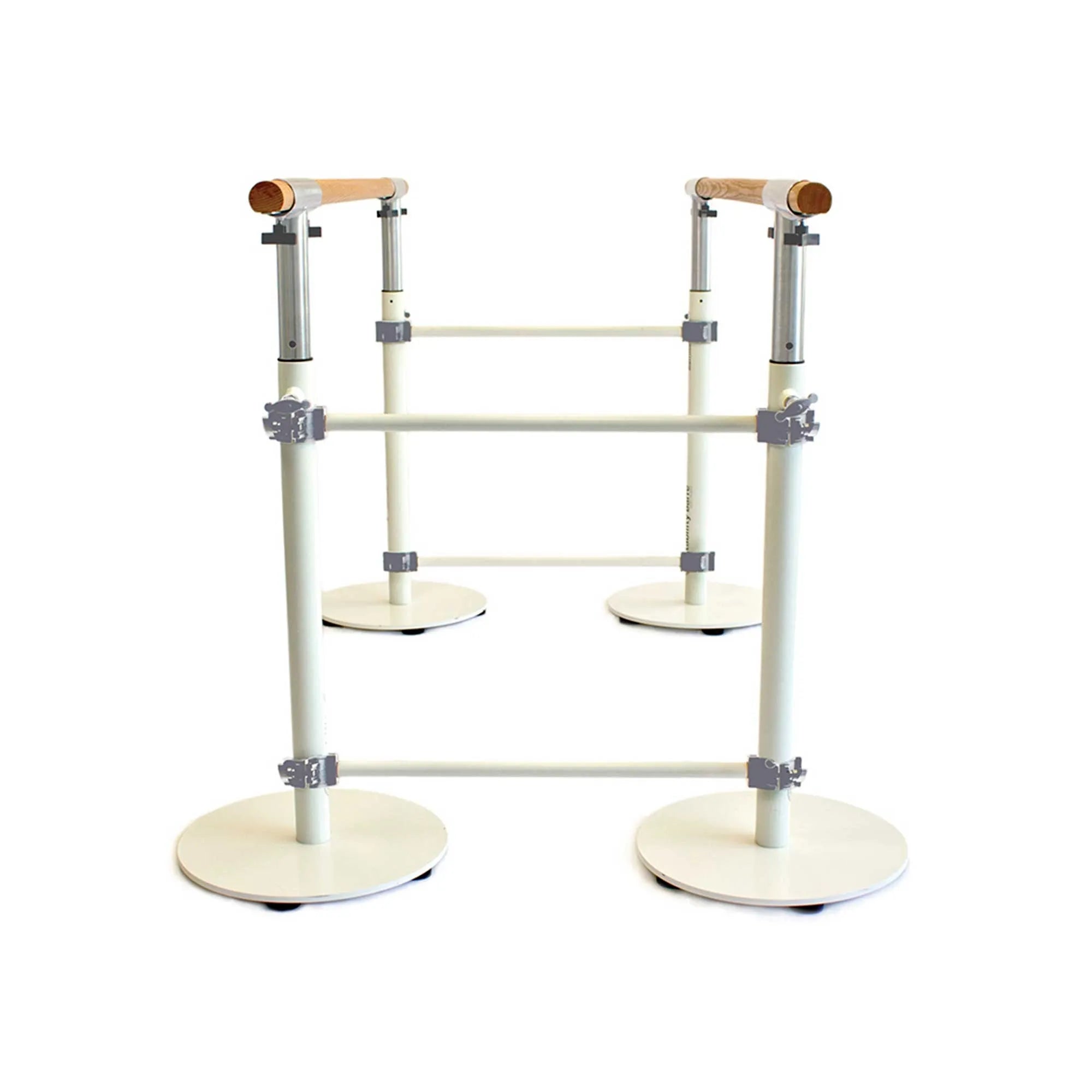
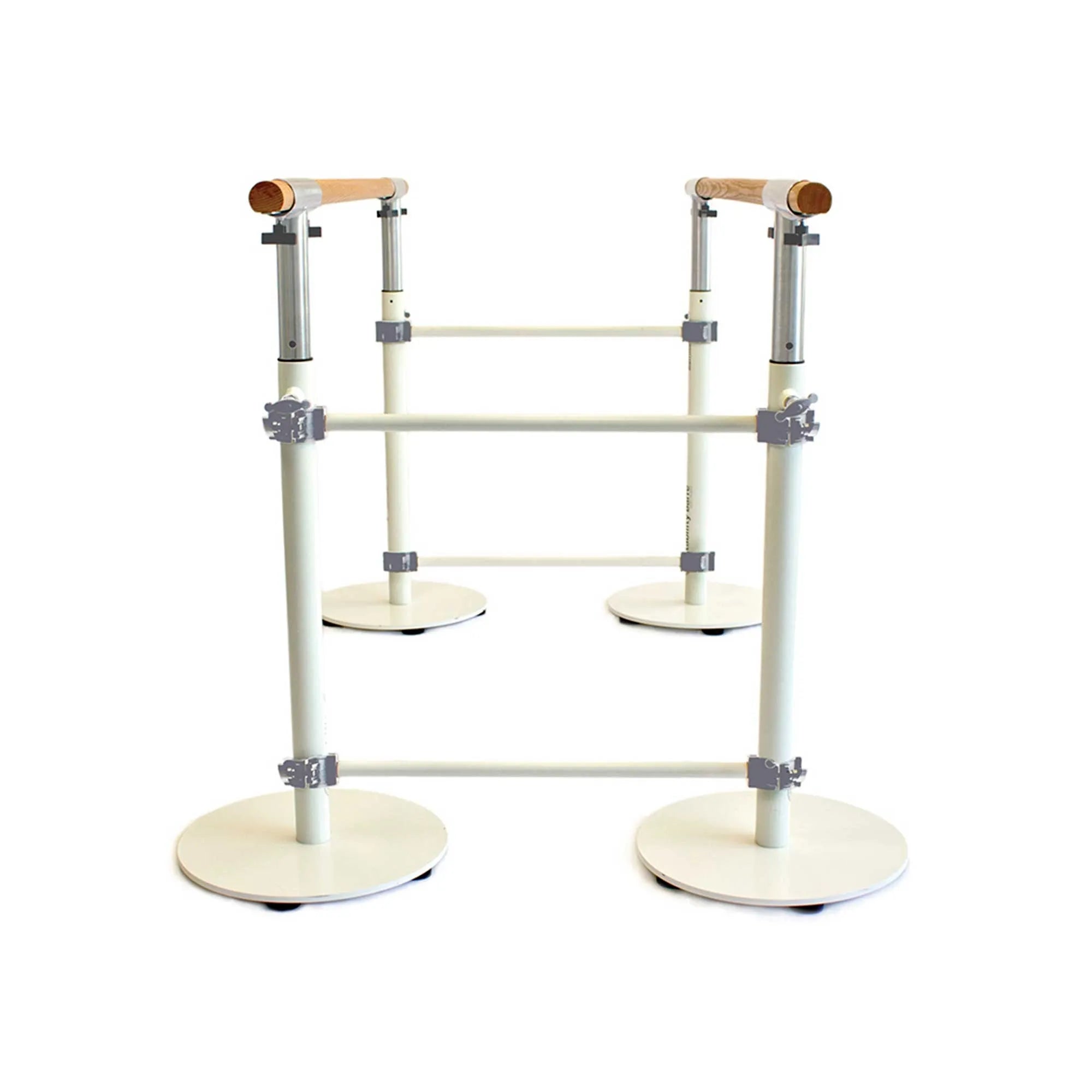
- Parallel Stability Barre Systems
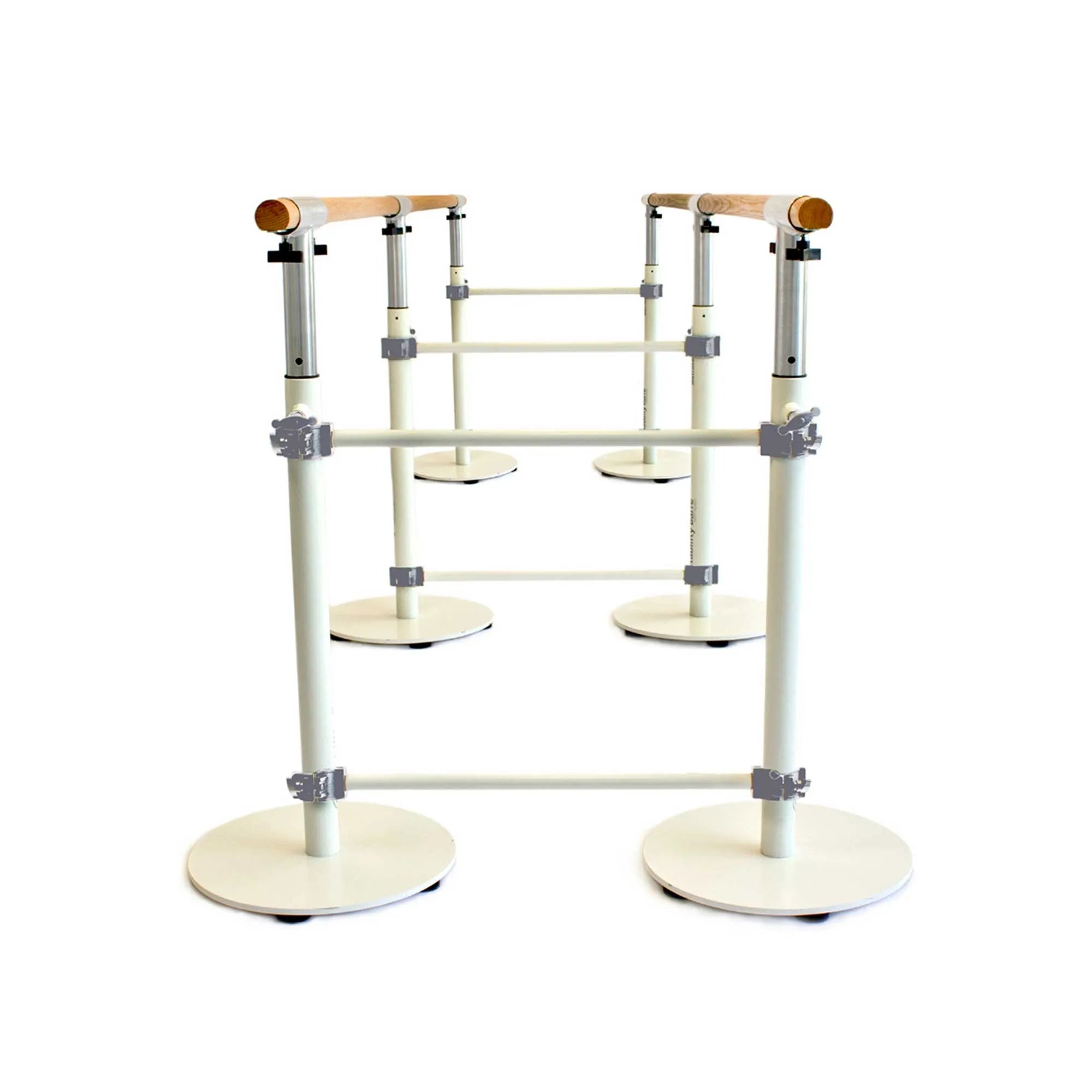
Double-sided configuration with two parallel barres for maximum class capacity. Includes four stability barre connectors for secure assembly. 6ft parallel accommodates 4 exercisers (2 per side), 8ft accommodates 6 exercisers (3 per side), 12ft accommodates 8 exercisers (4 per side). Ideal for group training and commercial studios.
- Wall-Mounted Options
Space-saving wall-mounted barres free up valuable floor space. Accommodate up to 3 users comfortably. Non-marking rubber end caps protect walls and floors. Durable construction for strengthening and toning exercises. Perfect for compact home gyms and multi-purpose studios. Hardware not included—requires wall installation.
- Adjustable Height System
Easily adjustable from 93-112cm (36.5-44 inches) to accommodate users of all heights and exercise variations. Adjustable levelers ensure stability on uneven floors. Quick-adjust mechanisms enable seamless height changes between exercises or users. Accommodates ballet positions, barre fitness routines, and stretching protocols.
- Weighted Stability Bases
Circular weighted bases (30kg / 66.1lbs per support) provide exceptional stability during dynamic movements. Non-skid grip works on hardwood, carpet, rubber flooring, and studio surfaces. Wide 40.6cm (16 inch) base footprint prevents tipping during vigorous exercises. No floor anchoring required.
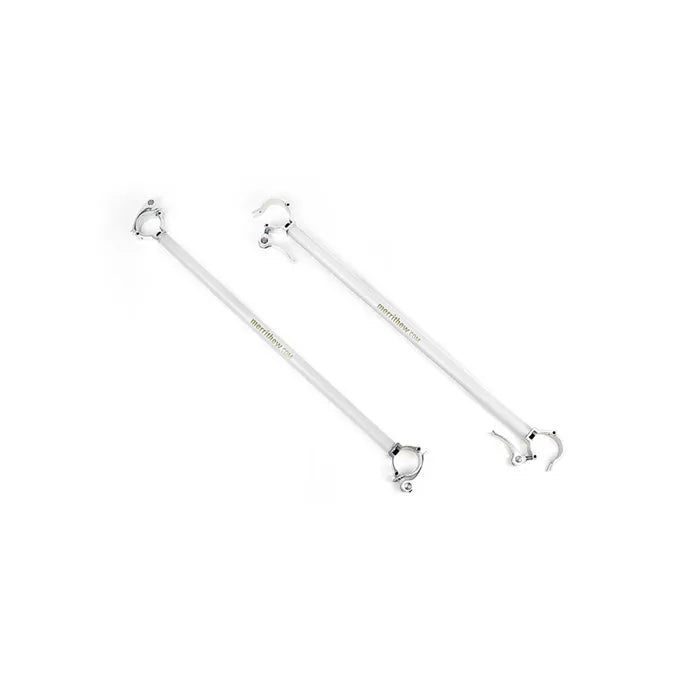
- Modular Connector System
Robust aluminum clamp connectors attach to barre uprights for secure parallel configurations. Easy snap-on installation requires no tools. Provides additional stability without wall mounts. Sold separately or included with parallel barre packages. Available in grey or white to match barre finish.
- Professional-Grade Construction
Solid steel frames engineered for commercial studio use. Powder-coated finishes resist scratches, chips, and wear. Smooth barre surfaces provide comfortable grip during extended sessions. Built to withstand daily high-volume classes. Suitable for both commercial and home use.
Benefits of Stability Barres
- For Lower Body Sculpting
Functional standing leg exercises combine traditional ballet barre work with movement patterns that tone, shape, and strengthen glutes, hips, thighs, and calves. Isometric holds build lean muscle and improve muscular endurance. Small, controlled movements target hard-to-reach muscle groups. Essential for barre fitness, ballet conditioning, and lower body sculpting.
- For Core Engagement & Stability
Barre work requires continuous core engagement to maintain proper alignment and balance. Standing exercises develop deep stabilizers (transverse abdominis, multifidus, pelvic floor) that traditional training misses. Improves posture, spinal alignment, and functional stability. Reduces back pain through strengthened core musculature.
- For Flexibility & Mobility
Barre provides stable support for deep stretches and mobility work. Enables controlled range-of-motion exercises that improve hip flexibility, hamstring length, and ankle mobility. Supports active flexibility development through strength at end ranges. Essential for dancers, athletes, and anyone seeking improved movement quality.
- For Balance & Proprioception
Single-leg exercises at the barre develop balance, coordination, and proprioceptive awareness. Progressive difficulty from two-hand support to one-hand to no-hand challenges. Improves neuromuscular control and reduces fall risk. Particularly beneficial for older adults and rehabilitation patients.
- For Full-Body Conditioning
Upper body exercises using the barre for support enable push-ups, planks, and arm work variations. Combines lower body sculpting with upper body strengthening for comprehensive conditioning. High-repetition, low-impact format builds endurance without joint stress. Suitable for all fitness levels.
- For Space Efficiency (Freestanding Models)
No wall mounting required—position anywhere in studio or home. Removable barres store compactly when not in use. Weighted bases provide stability without permanent installation. Ideal for multi-purpose spaces, rental studios, or home gyms without wall-mounting capability.
- For Group Class Capacity (Parallel Systems)
Double-sided parallel barres maximize class capacity in limited floor space. 12ft parallel accommodates 8 exercisers simultaneously. Enables efficient group instruction with all participants visible to instructor. Essential for commercial barre studios and group fitness facilities.
- For Professional Aesthetics
Sleek grey or white powder-coated finishes complement studio design. Professional-grade construction projects quality and attention to detail. Merrithew brand recognition signals commitment to premium equipment. Enhances studio ambiance and perceived value.
Buying Tips for Stability Barres
1) Choosing Barre Length
- 6ft Stability Barre
Capacity: 3 exercisers comfortably (single barre) or 4 exercisers (parallel configuration, 2 per side).
Best for: Home gyms, personal training studios, small group classes (3-4 participants), compact spaces.
Dimensions: Length 182cm (72 inches), Width 40.6cm (16 inches), Height adjustable 93-112cm (36.5-44 inches).
Weight: 30kg (66.1lbs) per support.
Considerations: Most compact option, adequate for individual practice and small groups, may feel crowded with 3+ users.
- 8ft Stability Barre
Capacity: 4 exercisers comfortably (single barre) or 6 exercisers (parallel configuration, 3 per side).
Best for: Boutique studios, medium group classes (4-6 participants), home studios with dedicated space.
Dimensions: Length 244cm (96 inches), Width 40.6cm (16 inches), Height adjustable 93-112cm (36.5-44 inches).
Weight: 30kg (66.1lbs) per support.
Considerations: Versatile mid-size option, balances capacity with footprint, most popular for boutique studios.
- 12ft Stability Barre
Capacity: 6 exercisers comfortably (single barre) or 8 exercisers (parallel configuration, 4 per side).
Best for: Commercial barre studios, large group classes (6-8 participants), dance schools, fitness facilities.
Dimensions: Length 366cm (144 inches), Width 40.6cm (16 inches), Height adjustable 93-112cm (36.5-44 inches).
Weight: 30kg (66.1lbs) per support.
Considerations: Maximum capacity, requires significant floor space (minimum 4m × 2.5m), ideal for dedicated barre studios.
2) Single vs. Parallel Configuration
- Single Stability Barre
Configuration: One barre with two weighted supports.
Capacity: 3-6 users depending on length (all on same side).
Best for: Home practice, personal training, small classes, wall-adjacent placement.
Advantages: Lower cost, smaller footprint, easier to reposition, adequate for most home users.
Considerations: All users face same direction, instructor must move around barre to observe all participants.
- Parallel Stability Barre
Configuration: Two barres connected with four connectors, creating double-sided system.
Capacity: 4-8 users depending on length (split between both sides).
Best for: Group classes, commercial studios, maximizing capacity in limited space.
Advantages: Doubles capacity, users face each other (community feel), instructor positioned centrally can observe all participants.
Considerations: Higher cost, larger footprint, requires connectors (included with parallel packages).
3) Freestanding vs. Wall-Mounted
- Freestanding Barres
Pros: No wall mounting required, position anywhere, removable for storage, weighted bases provide stability, portable for multi-purpose spaces.
Cons: Larger footprint than wall-mounted, weighted bases occupy floor space, higher cost than wall-mounted options.
Best for: Rental studios, multi-purpose spaces, home gyms without wall-mounting capability, facilities wanting flexibility.
- Wall-Mounted Barres
Pros: Space-saving (no floor footprint), lower cost, permanent installation, clean aesthetic.
Cons: Requires wall mounting (hardware not included), permanent placement, wall must support user loads, not portable.
Best for: Dedicated barre studios, permanent installations, compact spaces prioritizing floor area, facilities with suitable wall structures.
4) Space Planning
- Footprint Requirements
6ft single barre: 2m × 1m minimum (barre plus clearance).
8ft single barre: 2.7m × 1m minimum.
12ft single barre: 4m × 1m minimum.
6ft parallel barre: 2m × 2.5m minimum (includes both sides plus clearance).
8ft parallel barre: 2.7m × 2.5m minimum.
12ft parallel barre: 4m × 2.5m minimum.
- Clearance Considerations
Add 1m clearance on all sides for safe movement and exercise execution. Ceiling height: 2.4m minimum for standing exercises and arm work. Consider door widths for delivery and assembly—12ft barres may require assembly in-room.
- Flooring Compatibility
Non-skid bases work on hardwood, carpet, rubber flooring, vinyl, and studio surfaces. Weighted bases distribute load—no special flooring reinforcement required. Avoid placing on uneven surfaces—use adjustable levelers to compensate for minor irregularities.
5) Height Adjustment Guidelines
- Standard Heights
Waist height (93-100cm): Most common for barre fitness, ballet barre work, lower body exercises.
Chest height (100-107cm): Upper body work, push-ups, planks, stretching.
Shoulder height (107-112cm): Advanced stretching, flexibility work, specific ballet positions.
- User Height Considerations
Shorter users (under 160cm): Lower range 93-100cm typically adequate.
Average users (160-175cm): Mid-range 100-107cm most versatile.
Taller users (over 175cm): Upper range 107-112cm may be necessary.
Adjustability accommodates mixed-height classes and varied exercise requirements.
6) Assembly & Installation
- Freestanding Barres
Assembly required: 30-60 minutes with basic tools (wrenches, Allen keys).
Instructions included: Owner's manual with step-by-step assembly guidance.
Two-person job: Weighted bases and steel frames require two people for safe assembly.
No permanent installation: Simply position on floor and adjust levelers for stability.
- Wall-Mounted Barres
Hardware not included: Purchase appropriate wall anchors and screws based on wall type (drywall, concrete, brick).
Professional installation recommended: Ensure proper wall anchoring to support user loads.
Wall requirements: Studs or solid wall construction capable of supporting 100kg+ loads.
Permanent installation: Drilling required—not suitable for rental spaces without landlord approval.
- Connector Installation (Parallel Barres)
Tool-free: Aluminum clamps snap onto barre uprights without tools.
Four connectors included: Two per barre connection point for secure assembly.
Quick assembly: 10-15 minutes to connect two single barres into parallel configuration.
Reversible: Easily disconnect for storage or reconfiguration.
7) Finish & Colour Selection
- Grey Powder-Coated Finish
Aesthetic: Modern, neutral, professional appearance. Complements most studio colour schemes.
Practicality: Hides minor wear and scuffs better than white. Popular for high-traffic commercial studios.
Availability: Standard option across all barre lengths and configurations.
- White Powder-Coated Finish
Aesthetic: Clean, bright, traditional ballet studio appearance. Creates airy, open feel.
Practicality: Shows wear more readily than grey. Requires more frequent cleaning to maintain appearance.
Availability: Available across all barre lengths and configurations at same price as grey.
- Powder Coating Benefits
Scratch-resistant: Maintains appearance through daily commercial use.
Corrosion-resistant: Protects steel frame from moisture and sweat.
Easy to clean: Wipe with damp cloth and mild detergent.
Durable: Lasts years without refinishing in commercial environments.
Stability Barres - Frequently Asked Questions
What size stability barre do I need for home use?
6ft single barre accommodates 1-3 users comfortably and fits most home gyms (requires 2m × 1m space). 8ft provides more working space if you have room (2.7m × 1m). Most home practitioners find 6ft adequate unless regularly training with partners or small groups.
Do I need a parallel barre or single barre for my studio?
Single barres suit classes under 6 participants or studios with wall-adjacent placement. Parallel barres double capacity (4-8 users depending on length) and enable face-to-face positioning—ideal for group classes over 6 participants. Parallel configuration requires more floor space but maximizes capacity.
Can freestanding barres tip over during use?
No, when properly assembled and leveled, weighted bases (30kg per support) provide rock-solid stability. Non-skid grip prevents sliding on all flooring types. Adjustable levelers compensate for uneven floors. Designed and tested for vigorous barre fitness and ballet training.
Do wall-mounted barres come with mounting hardware?
No, hardware is not included because wall types vary (drywall, concrete, brick). Purchase appropriate wall anchors and screws based on your wall construction. Professional installation recommended to ensure proper anchoring for user safety. Wall must support 100kg+ loads.
How do I adjust the barre height?
Loosen adjustment mechanism on support uprights, raise or lower barre to desired height (93-112cm range), tighten to lock in place. Takes 30-60 seconds per support. Adjustable levelers on bases ensure stability after height changes. Consult owner's manual for specific adjustment instructions.
How many people can use a 12ft barre simultaneously?
Single 12ft barre: 6 exercisers comfortably (all on same side). Parallel 12ft barre: 8 exercisers (4 per side). Spacing allows approximately 60cm per person for comfortable movement without crowding. Actual capacity depends on exercise type and user size.
Can I connect multiple barres together?
Yes, using stability barre connectors (sold separately or included with parallel packages). Connectors attach to uprights to create parallel configurations or extend length. Aluminum clamps provide secure connection without tools. Maximum recommended is two barres connected (parallel configuration).
What flooring works best under stability barres?
Non-skid bases work on hardwood, carpet, rubber flooring, vinyl, and studio surfaces. Hardwood and rubber flooring most common in studios. Carpet provides additional grip but may compress under weighted bases. Avoid slippery surfaces like polished concrete without treatment.
How much space do I need around the barre?
Add 1m clearance on all sides for safe movement. Single 8ft barre requires 2.7m × 1m minimum; with clearance, plan for 3.7m × 2m total space. Parallel 8ft barre requires 2.7m × 2.5m minimum; with clearance, plan for 3.7m × 3.5m. Measure your space carefully before purchase.
Can I remove the barre from the supports for storage?
Yes, barres easily remove from supports for compact storage when not in use. Weighted bases can remain in position or be moved. Ideal for multi-purpose spaces that need to reconfigure between classes. Reinstallation takes minutes—simply place barre back in support brackets.