Nationwide Sales & Service - 01536 802333

Getting a treadmill into a home gym isn't just about floor space: you also need to plan for vertical clearance (step-on height, user height, and running movement) and safe space behind the machine for dismounts and falls. We have created this design led article to help breakdown the key design considerations, so you can ensure you buy the right machine for you and your space whilst also avoiding head knocks, cramped layouts, and unsafe setups.
Unlike a bike or rower, a treadmill raises you off the floor and adds dynamic vertical movement when you run. If the ceiling is too low, taller users (or anyone running at speed or incline) can come dangerously close to lights, beams, or ductwork.
A widely used rule of thumb is:
Minimum ceiling height = User height + Step-on (deck) height + Vertical movement allowance + Comfort/safety buffer
Where:
Simplified this to: User height + deck height + 38–60 cm (15–24 in) as a practical minimum.
Assume:
Minimum ceiling height ≈ 185 + 20 + 10 + 20 = 235 cm (about 2.35 m).
An 8 ft ceiling (≈ 244 cm) would be acceptable here, but only just; anything lower or any taller user would push you into risk territory, especially with incline.
When you run at incline, the front of the deck rises, effectively increasing the highest point of the belt and console. A 10–15% incline can add roughly 12–18 cm (5–7 in) to the front deck height depending on belt length and geometry.
For design purposes:
This is especially important in basements with beams, ducts, or sloped ceilings.

Step-on height (or deck height) is the vertical distance from the floor to the running belt when the treadmill is level. It affects:
Typical home treadmill step-on heights: 15–25 cm (6–10 in). Commercial-style or heavy-duty units can be higher.
When selecting a treadmill for a home gym with limited ceiling height, prioritise models that publish step-up/deck height and favour lower values where possible.
If you lose balance, stumble, or need to step off quickly, you need unobstructed space behind the treadmill. Hitting a wall, rack, or furniture during an emergency dismount significantly increases injury risk.
Industry standards and safety guidance converge on similar numbers:
In short: plan for at least 2 m (6.5 ft) of clear floor behind the treadmill if anyone will be running.
"Clear" means:
If your space can't provide 2 m behind the belt, consider:
Common guidance:
This matters for:
To estimate total floor area:
For a typical home treadmill (~1.8–2.0 m long × 0.8–0.9 m wide), the full "safety envelope" often ends up around 3.8–4.0 m in depth and 1.8–2.1 m in width.

Treadmills are heavy — typically between 80 kg and 180 kg for premium models — and generate significant vibration and impact. Ensure your floor can handle the load (particularly in upper-floor rooms), and invest in a purpose-designed equipment mat beneath the machine. This protects your flooring, reduces noise transmission, and prevents the treadmill from migrating across smooth surfaces during use.
Running generates body heat rapidly. Your treadmill room should have good natural ventilation or a dedicated air conditioning/cooling system to maintain a comfortable temperature during sustained sessions. Acoustic treatment — either wall panels or underfloor isolation — is also worth considering, particularly in multi-storey homes or where noise may carry to adjacent rooms.
Taking the time to plan these dimensions properly ensures your treadmill is not only safe to use, but genuinely enjoyable — a seamless part of a well-designed home gym rather than an afterthought squeezed into a space that doesn't quite fit.
Once you've confirmed your room can accommodate a treadmill safely, the next question is which type of machine is right for you. Treadmills are far from a homogeneous category — they range from compact folding units to self-powered curved decks, from richly featured workout platforms to architecturally considered design pieces and full club-grade installations. Understanding these distinctions helps you match the machine to the space, the aesthetic, and the kind of running experience you actually want.
For rooms that double up — a home office that becomes a gym, a bedroom with a workout corner, or a garage shared with storage — a folding treadmill is the most practical solution. When folded vertically, the deck tucks away and the machine's footprint reduces to a fraction of its deployed size, freeing up the floor for other uses when not in session.
The Inspire Fitness T5S is an excellent example of a folding treadmill that doesn't sacrifice quality for convenience. It offers a generous running surface, a robust motor, and a solid feel underfoot — qualities that many space-saving treadmills compromise on. Its folding mechanism is smooth and secure, and the machine holds its ground well during sustained effort. If your room needs to serve multiple functions and you're unwilling to compromise on the running experience, the T5S makes a compelling case for the category.
Best for: Multi-use rooms, apartments, garages with limited dedicated floor space, and users who want the flexibility to reclaim their space after training.
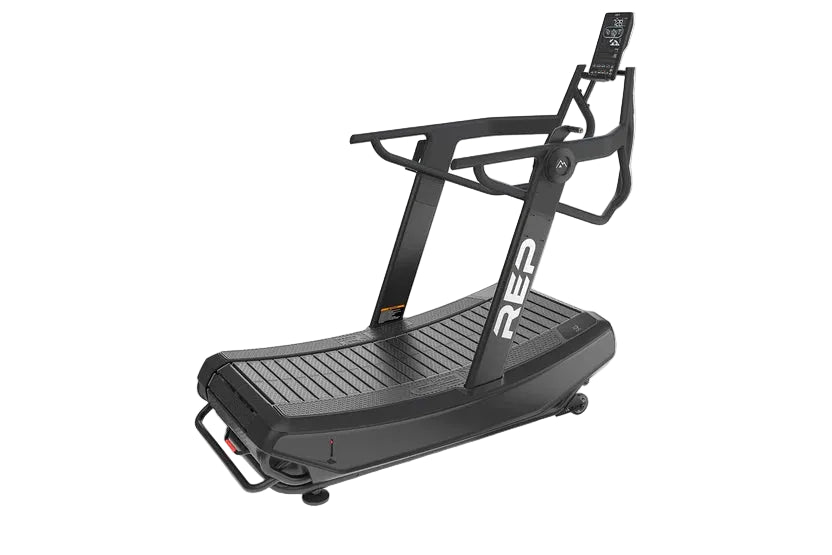
Curved treadmills require no motor. The belt moves entirely in response to your own stride — you drive it forward with each footfall, and it decelerates the moment you ease off. This mechanism fundamentally changes the biomechanics of the run, encouraging a more natural midfoot strike, a more upright posture, and a higher caloric output compared to equivalent efforts on a motorised deck. They are a favourite in high-performance training environments for good reason.
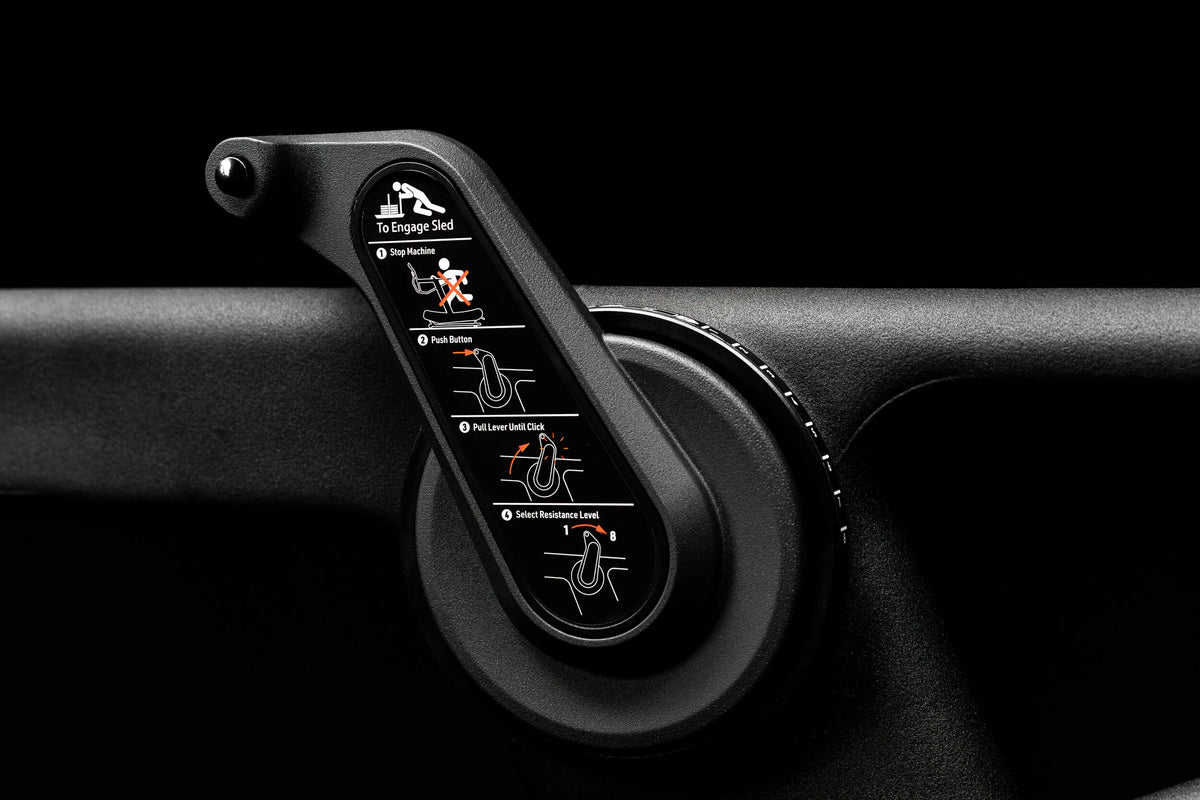
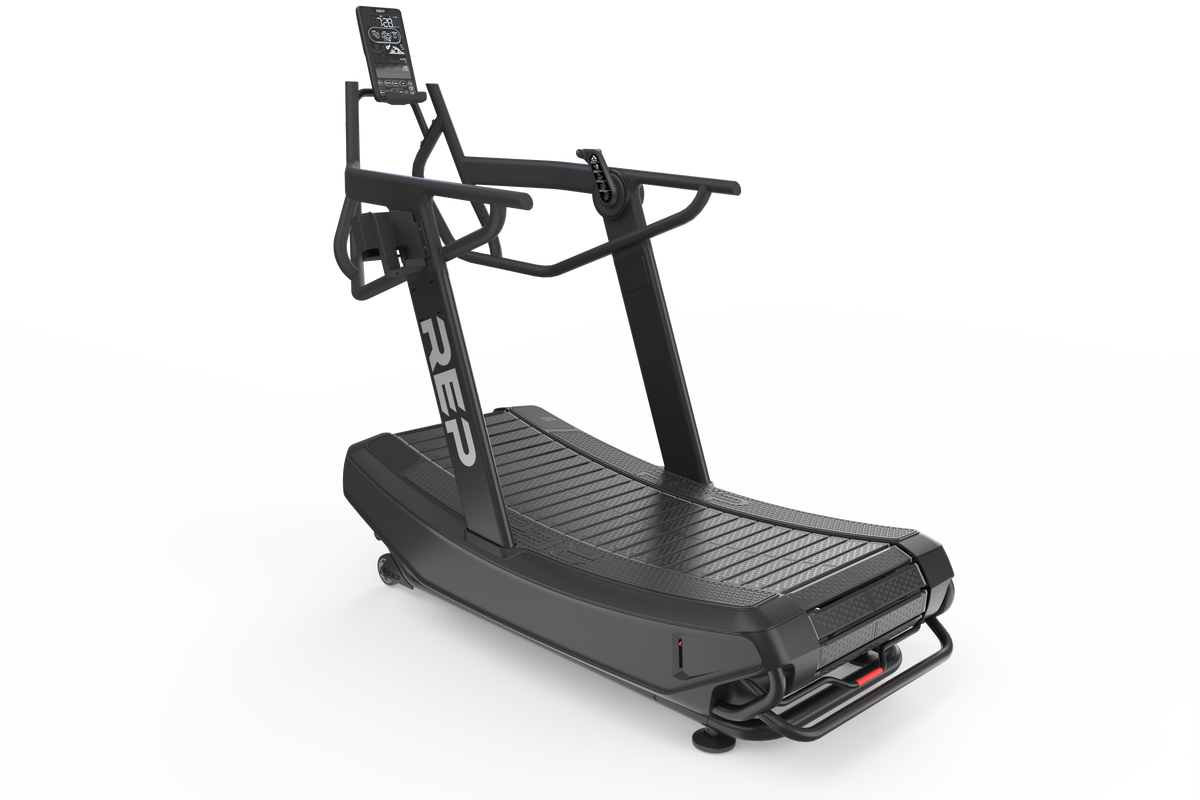
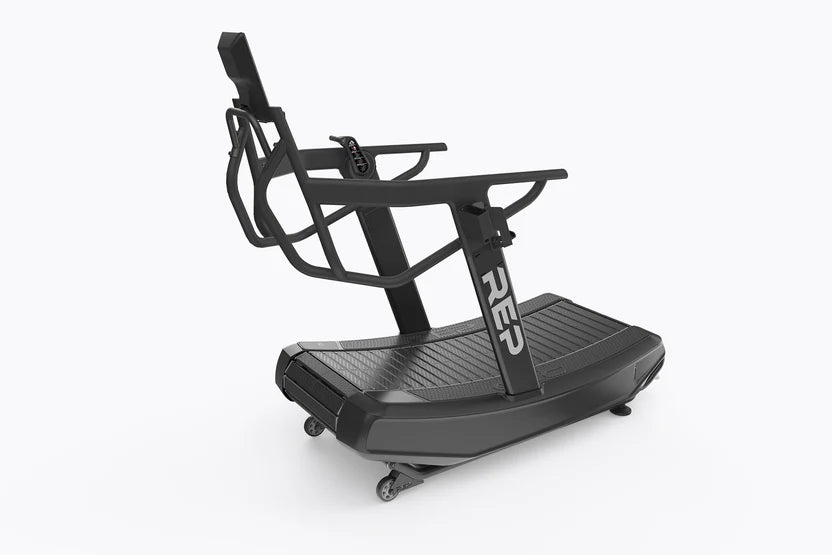
The REP Fitness Strive Treadmill brings this performance pedigree into a home gym context with a premium build quality and a clean, purposeful aesthetic. The Strive's curved deck encourages proper running mechanics from the first session, and its self-powered nature means no motor noise, no power socket dependency, and no motor wear over time. It is a machine that rewards committed runners — those who want their home training to feel as challenging and authentic as outdoor running, not a cushioned approximation of it.
Best for: Performance-focused runners, HIIT training, athletes seeking biomechanical integrity, and rooms where motor noise is a concern.

For those who find motivation in variety — structured classes, scenic routes, virtual coaching, and data-rich feedback — the priority shifts from machine mechanics to the ecosystem around the run. Workout experience treadmills are built around large, high-resolution touchscreens and deep integration with content platforms, transforming a standard run into an immersive session that holds your attention for the duration.
The NordicTrack Commercial 2450 is one of the most fully featured treadmills in this category. Its 24-inch rotating touchscreen gives access to iFit's expansive library of guided workouts, live instructor classes, and global scenic runs. The machine adjusts incline and speed automatically in response to trainer instructions, removing the cognitive load of self-managing intensity during a session. For users who struggle to sustain motivation on a treadmill alone, or who train best when led, the 2450 bridges the gap between gym class and home equipment convincingly.
Best for: Motivation-driven runners, those who follow structured programmes, families sharing equipment with varied fitness levels, and rooms set up for an entertainment-led training environment.
In a luxury home gym — particularly one conceived as a wellness space rather than a purely functional training room — the visual presence of equipment matters as much as its performance. A design-led treadmill is chosen not just for how it runs, but for how it looks when it's not being used. It becomes part of the room's character.
The NOHRd Citius is perhaps the finest expression of this philosophy available. Crafted from sustainably sourced hardwood with meticulous attention to detail, the Citius is a treadmill that sits as comfortably in a beautifully appointed room as it does in a gym. Its flowing form and natural materials echo NOHRd's wider design language — one that has made the brand a natural fit for spa facilities, boutique wellness studios, and high-end residential projects. Running on the Citius is a calm, refined experience; the machine is quiet, smooth, and thoughtfully engineered beneath its exceptional exterior.
Best for: Spa-inspired home gyms, architect- or designer-led interiors, wellness spaces where aesthetics and function carry equal weight, and buyers for whom the equipment itself is part of the room's design intent.
Some home gym owners want exactly what they experience in the best commercial facilities — the heft, the belt quality, the reliability, and the sheer confidence of a machine built to withstand thousands of hours of use. Club-style treadmills are engineered to commercial standards and bring that durability and performance into a private space.
The Life Fitness Club Series Treadmill is the definitive benchmark in this category. Life Fitness has equipped premier fitness facilities worldwide for decades, and their treadmills reflect that institutional pedigree — a wide, long running surface, an exceptionally well-cushioned deck, and controls designed for intuitive use at any speed. In a home environment, this translates to a machine that feels immediately familiar to anyone who trains in a serious gym, requires minimal maintenance, and will deliver consistent performance for years without compromise. It is the choice for those who want their home gym to genuinely replicate — and in some respects exceed — the club experience.
Best for: Serious or high-volume runners, ex-commercial gym users who want equivalent quality at home, large dedicated gym spaces, and buyers prioritising long-term reliability above all else.
No single treadmill type is universally superior — the right choice depends on the intersection of your space, your aesthetic, and the kind of relationship you want with your training. A compact multi-use room calls for the Inspire T5S; a performance-first training space may suit the REP Strive; a content-driven household might gravitate to the NordicTrack 2450; a design-conscious wellness environment will find its match in the NOHRd Citius; and those who want uncompromising club-grade quality will find it in the Life Fitness. Understanding these distinctions before you buy ensures the machine you choose becomes a genuine asset to your home gym — not merely a large and expensive piece of furniture.